Responsibility, Good Governance and Practice. A Look Back at the ISG x Widzew Łódź Foundation Conference
How do social responsibility and good governance translate into the day-to-day operations of sports organisations? How can we develop volunteering, create a safe environment for young athletes and move from diagnosing a problem to taking concrete action? These were some of the topics we discussed on 28 September at Widzew Łódź Stadium during a conference organised by the Institute for Sport Governance and the Widzew Łódź Foundation.
The event brought together representatives of sports clubs and academies, participants of the CSR in Sport Academy, students interested in sport management and partners of the international GGCS project. The programme combined presentations by experts and practitioners, workshops on good governance, exchange of experiences and the Sport Students’ Meet-up.
Why did we meet at Widzew?
The conference was opened by Marcin Tarociński, associated with Widzew Łódź and the Widzew Łódź Foundation, who welcomed the participants. He was followed by Paweł Zembura from the Institute for Sport Governance, who presented the programme and explained the broader context of the event.
One of the reasons for choosing Widzew as the conference venue was ISG’s long-running analysis of CSR activities undertaken by PKO BP Ekstraklasa clubs. Paweł Zembura highlighted the changes that have taken place at Widzew Łódź over successive seasons. For the past three seasons, the club has ranked as the responsibility leader in ISG’s analyses.
At the same time, Widzew’s example demonstrates that social responsibility is not the result of a single initiative, but a process developed consistently over the years. This perspective became one of the starting points for a discussion on how responsibility can be embedded in the day-to-day operations of a sports organisation.
From social initiatives to systemic support
Sylwia Dobrzycka, President of the Widzew Łódź Foundation, and Marcin Tarociński presented the Foundation’s current activities.
Participants learned about initiatives aimed at different social groups and how the Foundation continues to develop its work. An important theme was creating more equal opportunities for children and young people, including those from less economically privileged backgrounds, as well as initiatives supporting senior citizens.
The discussion demonstrated that the responsibility of a sports club can extend far beyond the pitch. A club and its foundation operate within a particular community, and their resources, visibility and organisational capacity can be used to respond to the real needs of its members.
Volunteering that also develops volunteers
Another perspective was presented by Marta Walas, Coordinator of the Widzew Łódź Foundation Volunteer Centre. She discussed the process of building and developing the Foundation’s volunteering programme and the solutions designed to ensure that the cooperation creates value for both sides.
One of these initiatives focuses on developing volunteers’ social skills. The aim is therefore not only to engage volunteers in specific tasks, but also to provide them with opportunities to gain new experiences and develop new competencies.
The Foundation also analyses the experiences of its volunteers, including whether they feel that their work has an impact and makes a meaningful contribution.
The organisational perspective was complemented by one of the Foundation’s volunteers, who shared his own experience. He emphasised that volunteering gives him an opportunity to develop in an area completely different from his everyday professional work, meet new people and build a sense of agency.
Responsibility for young athletes. The Borussia Dortmund perspective
An international perspective was brought to the discussion by Christian Diercks, Managing Director of the BVB Football Academy, who presented the way one of Europe’s most recognisable football academies operates and the philosophy behind its work.
In his presentation, he highlighted, among other things, the importance of high-quality coaching from the youngest age groups onwards. As he explained, developing young athletes should not mean that the best resources and coaches are reserved only for later stages of development. The BVB Football Academy works with around 650 coaches, and maintaining high standards is important regardless of the participants’ age.
Sporting development is only one element of the process. Diercks also discussed appropriate nutrition, the safety of children and young people, standards of conduct and procedures for responding to situations in which a participant may need support.
From this perspective, an academy’s responsibility does not end with developing football skills. It also involves creating a safe environment, supporting the development of young people and taking a conscious approach to the organisation’s responsibility towards those in its care.
From responsibility to action
The second part of the conference focused on good governance in sports organisations. It was also connected with the conclusion of the international GGCS project, co-funded by the European Union, implemented by the Institute for Sport Governance together with Sportlyanz. The conference at Widzew Łódź Stadium served as the project’s final event and provided an opportunity to summarise the activities carried out, exchange experiences and put the solutions developed within the project into practice.
This part of the event featured Jérôme Champagne and Victor Bredin from Sportlyanz, a partner in the GGCS project. They presented Sportlyanz’s approach to assessing how sports organisations operate, as well as experiences from its practical application. Participants then had the opportunity to use selected elements of this methodology during the workshop “From Responsibility to Action”.
The Sportlyanz methodology covers 10 areas and 89 control points, providing a structured way to examine how an organisation is actually governed. Areas that can be assessed include governance, consistency of the sporting project, communication and external stakeholders, compliance, risk management, sustainable development and ESG, human resources, sales and marketing, financial management, and the safety and security of people and property.
The starting point for the workshop was not only what values an organisation declares, but above all whether those values are reflected in its everyday decisions, written rules and actual practices. Participants therefore examined the potential gap between what an organisation says about itself through its mission, statutes or communications and what it actually does.
Good Governance Workshop in practice
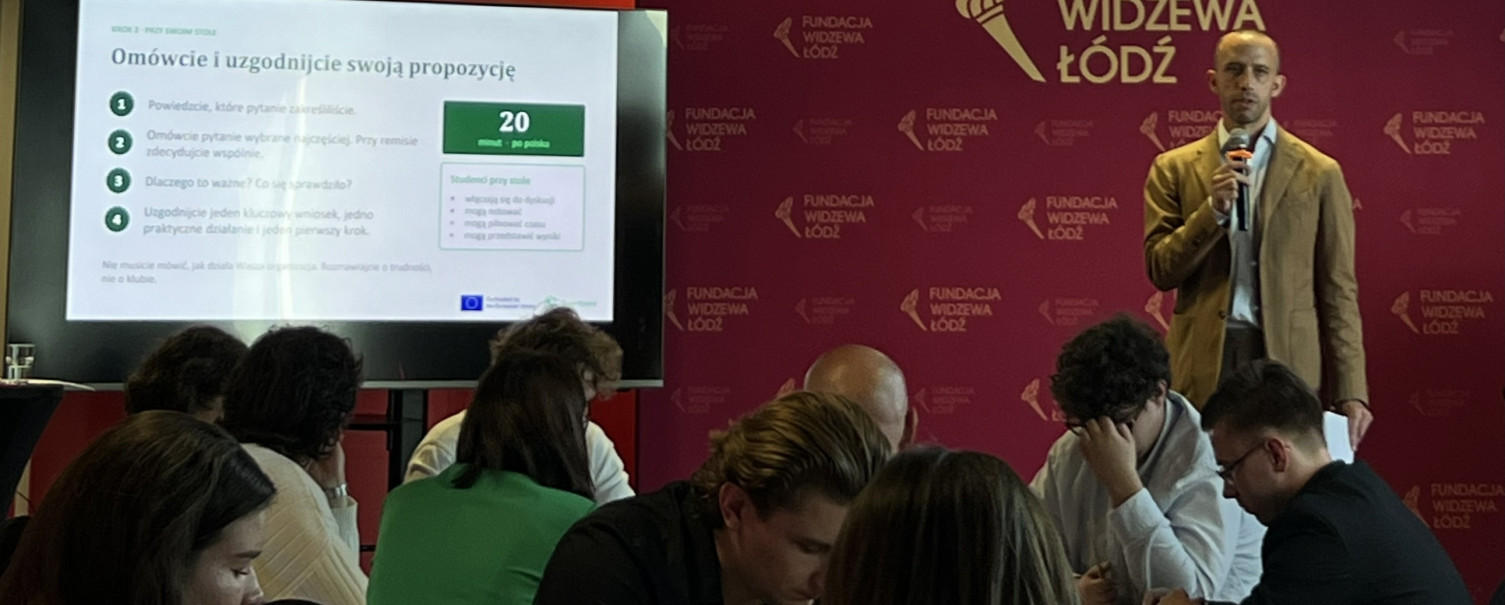
Following the introduction, participants moved on to the practical part of the workshop. Representatives of sports organisations and academies, together with students, were divided into mixed groups. Each table worked on one of three areas: the sporting project and responsibility towards young athletes, governance in the context of public funding and sponsors, or social and environmental responsibility.
The workshop was not an audit, certification process or comparison between organisations. Its purpose was to examine what was actually in place within organisations at that moment, identify areas requiring attention and move from diagnosis towards possible solutions.
Participants first worked individually with self-assessment worksheets, answering questions about their own organisations. They then shared their observations at their tables and selected an issue they wanted to analyse together. Students also actively participated in the discussions, contributing their own perspectives and supporting the moderation of group work and presentation of results.
Each group was asked to identify one key conclusion, one practical action and the first step towards implementing it. Participants also considered who could be responsible for the proposed action and how progress could be measured in the future. At the end, representatives of each table shared the results of their work with the other participants.
The workshop concluded with a question that captured its practical character:
What will you do differently when you return to your organisation?
Widzew from the inside
Following the intensive workshop session, participants also had the opportunity to explore the venue hosting the conference.
During a tour of the stadium, Marcin Tarociński introduced participants to the history of Widzew Łódź, discussing some of the most important moments in the club’s history and memorable matches. Participants were able to visit different areas of the stadium and step onto the pitch.
It was also a less formal part of the event, providing further opportunities for conversations and networking among participants.
The fourth Sport Students’ Meet-up
The final part of the day was the 4th edition of the Sport Students’ Meet-up, aimed at students interested in sport management.
The meeting began with presentations by representatives of student scientific associations. Students introduced their organisations and discussed the projects, conferences, events and other initiatives they undertake beyond their regular university programmes.
Theory then gave way to practice. Participants took part in a negotiation game centred around the organisation of the Olympic Games in Poland in 2044. Divided into groups representing different perspectives and interests, they had to negotiate with one another, work towards compromises and prepare a common position ahead of a final meeting with representatives of the International Olympic Committee.
The exercise generated a high level of engagement and demonstrated how many different interests, expectations and dependencies need to be reconciled when making decisions in sport.
Responsibility as a process
The conference at Widzew Łódź Stadium brought together perspectives that may initially seem quite different: a club’s social initiatives, volunteering, the development of young athletes, governance, financial and risk management, cooperation with sponsors and the development of the future workforce of the sports sector.
Their common denominator, however, was responsibility understood not as a single initiative or declaration, but as a way of making everyday decisions within an organisation.
This was captured in the question with which Sportlyanz concluded the workshop:
What will you do differently when you return to your organisation?
We would like to thank the Widzew Łódź Foundation, all speakers, Sportlyanz, conference participants, representatives of sports organisations and academies, students and student scientific associations for a day filled with discussions, exchange of experiences and active participation in the workshops.
See you at our future events!