September 2026 at ISG: From Knowledge to Practice in Responsible Sport

September was a month in which many of the topics we have been exploring at the Institute for Sport Governance over recent months took on a very practical dimension. Good governance, social responsibility, the development of young athletes and sustainability featured not only in our analyses and publications, but also at international meetings, seminars and our conference at Widzew Łódź Stadium.
Responsibility and Good Governance at Widzew Łódź Stadium
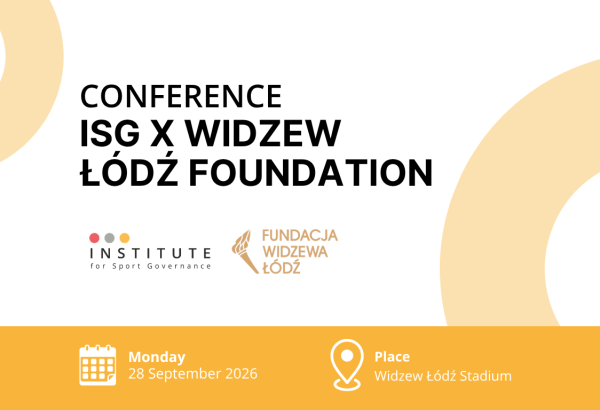
One of the key events of the month was the “Responsibility and Good Governance in Sport” conference, which we organised together with the Widzew Łódź Foundation on 28 September. The event brought together representatives of clubs, academies and other sports organisations, participants of the CSR Academy in Sport, students, experts and partners of the international GGCS project.
We discussed Widzew Łódź’s social and CSR initiatives, the development of volunteering, and the responsibility of sports academies towards young athletes. An important part of the event was the Good Governance Workshop led by Jérôme Champagne and Victor Bredin from Sportlyanz. Participants worked on real challenges faced by their organisations, moving from self-assessment and diagnosis to identifying priorities and concrete actions. The conference also served as the final event of the GGCS project.
The 4th edition of the Sport Students’ Meet-up also took place on the same day. Students from different universities not only presented the activities of their student research clubs, but also took part in a negotiation game focused on the organisation of the Olympic Games in Poland in 2044. It was an opportunity to experience first-hand the complexity of decision-making processes, negotiations and the different interests involved in sport.
FEMCoach: Knowledge to Support Young Female Athletes
September was also an important month for the FEMCoach project. On 7–8 September, the 2nd FEMCoach International Seminar, entitled “Training Female Youth Athletes: How Should We Train Them?”, took place in Girona and Banyoles. Poland was represented by ISG and four coaches participating in the programme: Anna Maria Kubiak, Anna Stangret, Małgorzata Lipowska and Zofia Skomra.
The lectures, discussions and workshops covered topics including the development and maturation of young female athletes, female hormonal health, communication, feedback and neuromuscular training. In September, we also introduced the Polish FEMCoach participants and highlighted their diverse professional backgrounds. All of these stories share one important message: developing a coach’s competencies influences not only her own work, but also the quality of the experiences of the young people she works with.
Climate Change Is Increasingly Shaping the Way Sport Is Managed
In September, we also returned to the challenges associated with climate change. During the World Athletics Championships in Tokyo, athletes competed in temperatures exceeding 30°C and humidity levels above 90%. Sebastian Coe pointed out that the international sports calendar may need to be redesigned in the future, including by changing the timing of endurance events.
At the same time, the examples of Edgbaston Stadium and the International Hockey Federation showed how sports organisations can respond to environmental challenges in practice. Edgbaston is developing solutions related to renewable energy, public transport, waste management and more sustainable catering, while the FIH is working to reduce the amount of water required for field hockey surfaces.
ISG at EASM 2026
In September, we also attended the 34th European Association for Sport Management Conference in Thessaloniki. ISG was represented by Dr Grzegorz Botwina and Mateusz Boczyło. The conference covered topics including good governance, sustainability, ESG, safeguarding, inclusion, sports policy and new technologies. Another important theme was collaboration between research and practice, and how research findings can be translated into solutions used by sports organisations.
Above all, September showed that responsibility in sport can no longer be reduced to a single area. It encompasses how organisations are governed, how they work with young athletes, their environmental impact, their relationships with communities and their preparedness for emerging risks. Ultimately, the best test of these principles is how effectively they translate into everyday practice.